
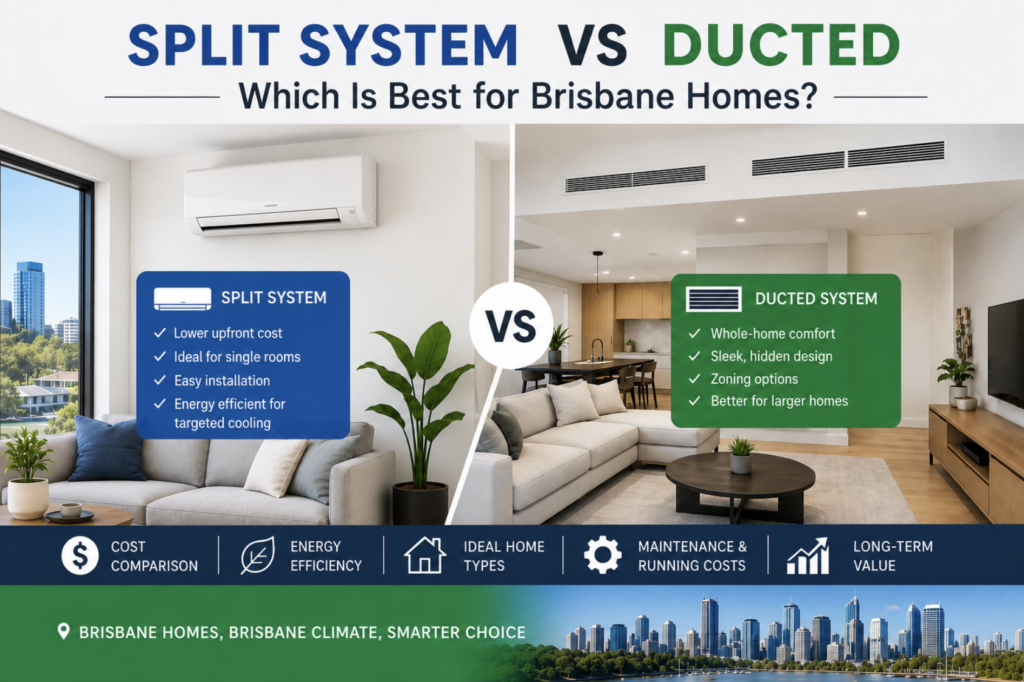
The choice between ducted and split system air conditioning isn’t always straightforward. Ducted air conditioning provides whole-home climate control through ceiling or floor ducts and is ideal for larger spaces. Split systems offer room-specific cooling that’s easier to install. The costs differ as well. To name just one example, a 2.5-kilowatt split system consumes around 511 kilowatt-hours annually and costs about $110. A ducted system with similar capacity incurs approximately $0.91 per hour in energy expenses. In this piece, we’ll break down what split system air conditioning versus ducted air conditioner systems are, compare their benefits and costs, and help you determine which option suits your needs best.
What is Ducted Air Conditioning
Ducted air conditioning operates as a centralized system that delivers conditioned air throughout your property via concealed ductwork. The setup consists of a single outdoor unit connected to an indoor unit typically installed in the roof cavity or under the floor.
How Ducted AC Systems Work
The system functions through a refrigeration cycle that draws warm air from rooms through return air grilles. This air passes over evaporator coils containing refrigerant, which absorbs heat and transforms into gas. Flexible insulated ducting then distributes the cooled air to vents in each room. The heated refrigerant gas travels to the outdoor compressor unit, where it’s pressurized and converted back to liquid and releases heat outside. This process reverses for heating.
Modern systems include motorized dampers within ductwork that control airflow to specific zones. Wall-mounted controllers or mobile applications manage temperature settings and zone activation. Diffusers release air, return air grilles with filters remove dust, and zone motors enable independent area control.
Key Benefits of Ducted Air Conditioner System
Ducted systems maintain uniform temperatures across large spaces and eliminate hot and cold zones. The esthetic advantage is most important since indoor components hide within ceiling cavities and leave only subtle vents visible. This discretion preserves architectural integrity and may increase property valuations.
Inverter technology and zoning capabilities improve energy efficiency. Smart ducted units can reduce power consumption by up to 40%, while zone control directs conditioned air only where needed. The systems operate quietly since noise-producing components remain concealed or positioned outside. Ducted systems can last 10-15 years or more with proper maintenance.
Limitations of Ducted Systems
Installation costs represent the biggest problem and range from AUD 9,000.00 to AUD 38,224.76 depending on home size. The complexity demands extensive planning, ceiling cavity access and structural modifications. Modernizing existing homes often encounters obstacles including limited roof space. Maintenance requirements increase due to multiple components requiring attention, including filters, dampers, motors and ductwork networks.
What is Split System Air Conditioning
Split system air conditioners comprise two separately installed components that work together to regulate indoor temperatures. An indoor unit mounted on walls or ceilings has the evaporator coil and fan. An outdoor unit houses the compressor and condenser. These units connect through refrigerant lines and electrical wiring. Installation requires only a small 3-inch hole.
How Split Systems Operate
The refrigeration cycle drives split system functionality. The refrigerant evaporates inside the indoor unit’s evaporator coil during cooling mode and absorbs heat from room air. This warm refrigerant travels to the outdoor compressor. The compressor pressurizes it into hot gas. The condenser coil then releases this heat outside and converts the refrigerant back to liquid. The cooled refrigerant returns indoors to repeat the cycle. The process reverses for heating and extracts heat from outdoor air to deliver it inside.
Multi-split configurations allow multiple indoor units to connect to one outdoor unit. Temperature control across different rooms becomes possible while requiring just one external component.
Advantages of Split System Air Conditioners
Energy efficiency stands out with ratings up to 28.5 SEER2 for cooling and 18 HSPF2 for heating. Conditioned air enters rooms without ductwork. These systems avoid the energy losses common in ducted setups. Installation proves simpler because no extensive ductwork is needed.
Zone control enables heating or cooling specific areas independently. Energy waste in unoccupied spaces reduces. Noise levels remain low. The compressor sits outside while indoor units operate on variable speed fans. The systems suit room additions and conversions where extending ductwork would be impractical.
Drawbacks of Split Systems
Professional installation is mandatory. Original costs increase compared to portable units. Each indoor unit requires corresponding outdoor unit space, which may limit placement options. Larger rooms might need multiple units for adequate coverage. Ducted systems handle expansive areas more unobtrusively. Indoor units remain visible on walls and potentially disrupt room esthetics. Regular maintenance has filter cleaning every two weeks and periodic refrigerant checks.
Cost Comparison: Ducted or Split System
Installation Costs
Upfront expenses vary between these systems. Split system installation ranges from AUD 917.39 to AUD 8,409.45 for single units, while ducted systems cost between AUD 9,000 and AUD 22,934.85 for medium homes. But multiple split systems across several rooms can approach ducted pricing.
Running Costs and Energy Efficiency
Split systems consume between 0.5-1 kW per hour and cost about AUD 0.38 to AUD 1.15 hourly. Ducted systems require AUD 2.22 to AUD 5.28 per hour, reflecting their larger coverage. A 2.5kW split system uses about 511 kilowatt-hours annually at AUD 168.19. Ducted systems with 2.6 power input incur AUD 1.39 hourly. Zoning reduces ducted consumption by directing air only to occupied areas.
Long-Term Value and Maintenance Costs
Split system servicing costs around AUD 305.80 per unit. Ducted maintenance reaches about AUD 611.60 due to system complexity. Repair expenses differ, so ducted repairs cost more. A unit that’s poorly maintained consumes 15-30% additional electricity.
Factors That Affect Your Energy Bills
Thermostat settings affect costs by a lot. Each degree adjustment changes energy consumption by 10%. System capacity and insulation quality both influence running expenses, along with climate conditions. Inverter technology can reduce costs by 30-50% compared to non-inverter models.
Choosing Between Ducted vs Split System Air Conditioning
Selecting the appropriate system hinges on how you use your space and what you need from climate control.
Best Applications for Ducted Systems
Ducted systems excel in larger homes, offices, and new builds where multiple rooms require simultaneous conditioning. Family homes with open-plan designs benefit from uniform temperature distribution across the property. Commercial spaces needing consistent comfort throughout also favor ducted installations.
When Split Systems Make More Sense
Split systems suit individual rooms, small apartments, or offices where cooling one area at a time meets your requirements. Bedrooms, living rooms, and home offices represent ideal applications. Properties with space limitations or structural constraints that prevent ductwork installation find split systems more practical.
Key Factors to Think About
Property characteristics, usage patterns, and financial capacity are the main factors that drive the decision.
Room Size and Home Layout
Large homes with multiple rooms needing simultaneous conditioning favor ducted setups. Smaller homes, units, or situations requiring specific space conditioning work better with split systems. Open-plan layouts benefit from ducted whole-house comfort.
Climate Control Needs
Whole-house even comfort points toward ducted systems. Households where family members prefer different temperatures, or where only select rooms see regular use, gain flexibility from split systems.
Budget Considerations
Split systems cost less upfront for one or two rooms. Ducted systems demand higher original investment but may prove worthwhile for whole-house conditioning and long-term property value.
Comparison Table
Comparison Table: Ducted vs Split System Air Conditioning
| Feature | Ducted Air Conditioning | Split System Air Conditioning |
| System Description | Centralized system with concealed ductwork, single outdoor unit connected to indoor unit in roof cavity or under floor | Two separate components: indoor unit (wall/ceiling mounted) and outdoor unit, connected through refrigerant lines |
| Installation Cost | AUD 9,000 – AUD 12,000 (small homes) AUD 12,231.92 – AUD 22,934.85 (medium homes) AUD 21,405.86 – AUD 38,224.76 (based on home size) | AUD 917.39 – AUD 8,409.45 (single units) |
| Running Cost (Hourly) | AUD 2.22 – AUD 5.28 per hour AUD 0.91 per hour (like a 2.5kW split) AUD 1.39 per hour (2.6 power input) | AUD 0.38 – AUD 1.15 per hour 0.5-1 kW per hour consumption |
| Running Cost (Annual) | Not mentioned for standard comparison | Approx. AUD 168.19 (2.5kW system, 511 kWh per year) |
| Maintenance Cost | Approx. AUD 611.60 | Approx. AUD 305.80 per unit |
| Energy Efficiency | Up to 40% reduction with smart inverter technology and zoning; 30-50% savings with inverter vs non-inverter | Up to 28.5 SEER2 (cooling) and 18 HSPF2 (heating); no ductwork energy losses |
| Lifespan | 10-15 years or more with proper maintenance | Not mentioned |
| Noise Level | Quiet operation (noise-producing components concealed or outside) | Low noise (compressor outside, indoor units on variable speed fans) |
| Esthetic Effect | Minimal – components hidden in ceiling cavities, only subtle vents visible; preserves architectural integrity | Indoor units visible on walls, may disrupt room esthetics |
| Coverage Area | Whole-home climate control; ideal for large spaces and multiple rooms | Room-specific cooling; may need multiple units for larger rooms |
| Best Applications | Larger homes, offices, new builds, open-plan designs, commercial spaces, family homes needing multi-room conditioning at once | Individual rooms, small apartments, offices, bedrooms, living rooms, home offices, room additions and conversions |
| Zone Control | Yes – motorized dampers control airflow to specific zones | Yes – independent temperature control for different rooms with multi-split configurations |
| Installation Complexity | Complex – requires extensive planning, ceiling cavity access, and structural modifications; difficult to update | Simpler – no extensive ductwork needed; requires only 3-inch hole; professional installation mandatory |
| Key Advantages | Uniform temperatures across large spaces; discreet appearance; may increase property value; whole-house comfort | Energy efficient; easier installation; zone control; suitable for limited spaces; direct air delivery without duct losses |
| Biggest Limitations | High installation costs; complex installation; increased maintenance requirements; limited roof space in updates | Visible indoor units; requires outdoor unit space for each indoor unit; multiple units may be needed for large rooms; professional installation required |
| Maintenance Requirements | Multiple components (filters, dampers, motors, ductwork networks) | Filter cleaning every two weeks; periodic refrigerant checks |
Note: Poor maintenance can increase electricity consumption by 15-30% for both systems. Each degree of thermostat adjustment changes energy consumption by 10%.
Conclusion
The ducted vs split system debate doesn’t have a universal winner. Your ideal choice depends on your specific circumstances. Split systems offer affordable, room-specific cooling that’s perfect for smaller spaces or targeted comfort. Ducted systems deliver whole-home climate control that suits larger properties and open-plan layouts.
I’d recommend this approach: choose split systems for budget-conscious projects or individual room cooling. Pick ducted if you’re building new and need consistent comfort throughout your entire home with clean esthetics.
FAQs
Q1. Which system is more cost-effective to operate – ducted or split air conditioning? Split systems are generally cheaper to run, consuming 0.5-1 kW per hour and costing approximately AUD 0.38 to AUD 1.15 hourly. Ducted systems require AUD 2.22 to AUD 5.28 per hour due to their larger coverage area. However, if you need to cool your entire home simultaneously, ducted systems can be more efficient than running multiple split units.
Q2. Can I control different temperatures in different rooms with these systems? Yes, both systems offer zone control capabilities. Ducted systems use motorized dampers to direct airflow to specific zones, while split systems allow independent temperature control for each room. This flexibility helps reduce energy waste by conditioning only the spaces you’re actively using, rather than cooling or heating unoccupied areas.
Q3. How much does it cost to install ducted versus split system air conditioning? Split system installation typically ranges from AUD 917 to AUD 8,409 for single units, making them more affordable upfront. Ducted systems cost between AUD 12,232 and AUD 22,935 for medium homes due to the complexity of ductwork installation. However, installing multiple split systems throughout a home can approach ducted pricing.
Q4. Which system is better for a large family home? Ducted systems excel in larger homes where multiple rooms require simultaneous conditioning, providing uniform temperature distribution throughout the property. They’re particularly effective in open-plan designs and family homes. Split systems work better for smaller homes or situations where only specific rooms need cooling at different times.
Q5. What are the maintenance requirements and costs for each system? Split systems require filter cleaning every two weeks and periodic refrigerant checks, with annual servicing costing around AUD 306 per unit. Ducted systems have more complex maintenance needs including filters, dampers, motors, and ductwork networks, with servicing costs reaching approximately AUD 612. Poor maintenance can increase electricity consumption by 15-30% for both systems.