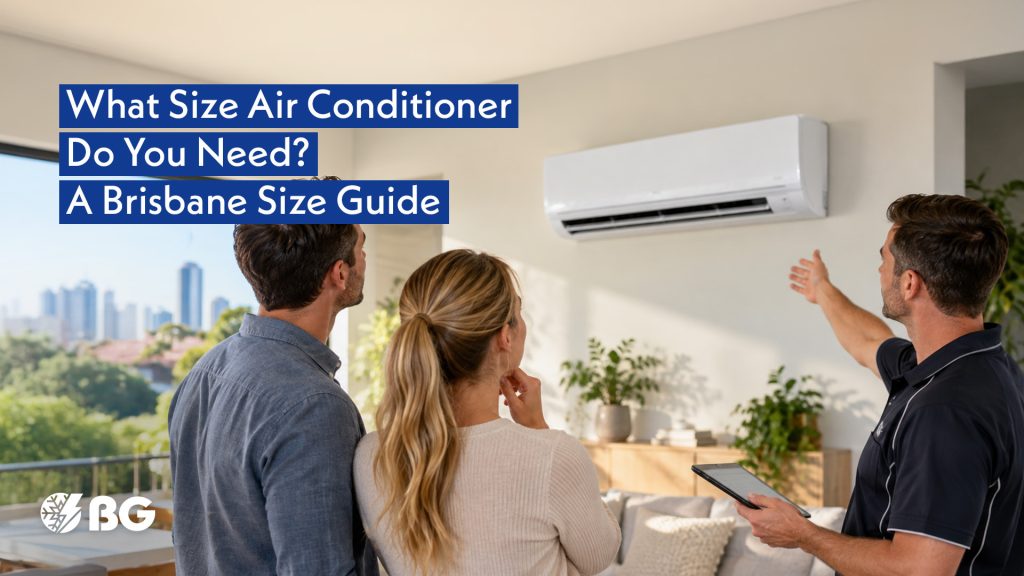
As a rough size guide, allow around 0.125 to 0.15 kilowatts of cooling capacity for every square metre in a well insulated room. A small bedroom of around 15 square metres usually needs a 2.5kW split system, while a large open plan living area of 40 square metres often calls for a 6 to 7kW unit. That said, an onsite assessment is the only way to get an exact figure, since ceiling height, insulation and window orientation all shift the numbers. As a licensed refrigeration mechanic who sizes systems for Brisbane homes every day, getting this right matters more than most people realise.
Why Does the Right Size Actually Matter?
An undersized air conditioner runs flat out trying to hit the temperature you have set, working overtime on our stickier Brisbane afternoons and never quite getting there. It wears out faster, uses more power for the result you get, and leaves rooms feeling only just cool enough. An oversized unit has the opposite problem. It cools the room too quickly, switches off before it has properly removed the humidity, then kicks back on again a few minutes later. This short cycling drives up your power bill and leaves the room feeling cold and clammy at the same time, which is not the outcome anyone is after.
How Do I Use a Size Guide to Work Out My Own Numbers?
Start by measuring the length and width of the room in metres and multiplying them together for the floor area. Multiply that figure by 0.125 to 0.15 kilowatts to get a baseline capacity. A 20 square metre bedroom, for example, lands somewhere around 2.5 to 3 kilowatts, which usually rounds to a 2.5kW split system.
That baseline shifts depending on a few things. Higher ceilings hold more air, so anything above the standard 2.4 metres needs a bump up in capacity. Rooms with large west facing windows cop the harshest afternoon sun and need more cooling power than a shaded, north facing room of the same size. Older homes with little or no ceiling insulation lose their cool air faster, so factor in a bit extra there too.
What About Sizing a Whole Home With Ducted Air Conditioning?
Sizing an entire house is more involved than sizing one room, since a ducted system needs to account for every zone running at once, plus how the ductwork itself is laid out. As a general size guide, a typical four bedroom Brisbane home lands somewhere between 14 and 18 kilowatts total capacity, though this depends heavily on the number of zones, orientation and how open plan the living areas are. This is genuinely a job for a proper onsite assessment rather than a rule of thumb, since getting a whole home system wrong is a far more expensive mistake than getting one room wrong.
Can I Just Go Bigger to Be Safe?
It is a common assumption, but no. A bigger unit costs more to buy, more to install in some cases, and more to run, all while giving you a worse result through short cycling. The Energy Rating website puts it plainly, an oversized system costs you more upfront and in ongoing running costs, while an undersized one works harder and still may not keep the room comfortable. Matching the unit to the room is what actually saves you money, not buying more capacity than you need.
Does My Climate Zone Change the Sizing?
Yes. Brisbane’s warm, humid climate means our air conditioners are working to remove moisture as well as heat, which is a different job to a dry inland climate. If you are comparing capacities online, keep in mind that many sizing charts are based on a generic Australian average rather than our specific conditions. CHOICE has a useful breakdown of how air conditioner sizing changes by location, which is worth a read if you want to understand the reasoning rather than just take a number at face value.
When Should I Just Get a Professional Assessment?
Any time you are installing a new system, upgrading an old one, or noticing that your current unit never seems to keep up, it is worth having someone qualified actually look at the room rather than guessing from a chart. If your existing system already feels like it is fighting a losing battle, it might not be the unit itself but the sizing that was wrong from day one, and our air conditioning repairs team sees this more often than you would expect.
Getting It Right the First Time
A size guide gets you in the right ballpark, but every Brisbane home is different, and small details like ceiling height, insulation and sun exposure all move the number. We offer free onsite quotes across Brisbane, where we measure the actual room, factor in your home’s specific conditions, and recommend a split system or ducted setup sized properly for your space, not just a generic number off a chart.